Home»News»From 200 wheelbarrow loads and 12 man-hours to just 2 hours of light work
From 200 wheelbarrow loads and 12 man-hours to just 2 hours of light work
27 August 2026
After many years, Ad van Onzenoort chose SHERPA again.
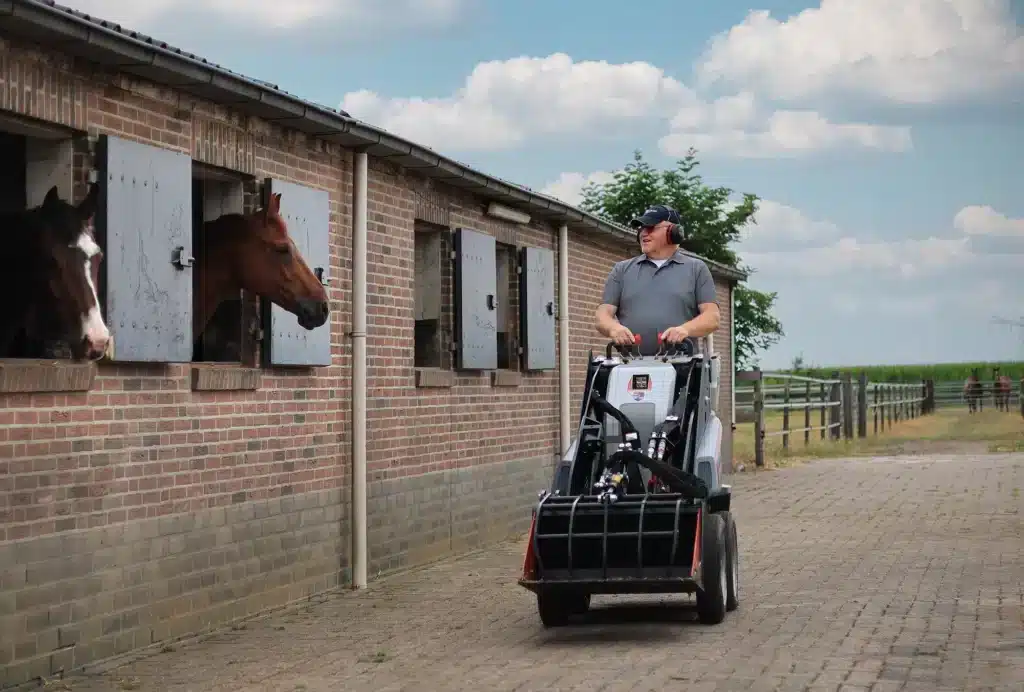
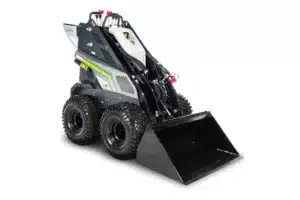
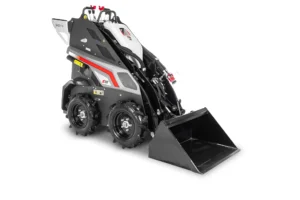
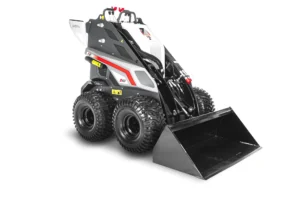
Every Wednesday, AVO Stables faced a sizeable job. The stables had to be mucked out, which meant moving around 200 full wheelbarrows of manure outside. With three people, it took Ad van Onzenoort about four hours, a total of twelve man-hours. Today, the same job is finished in around two hours. Ad does virtually all of it himself with his new SHERPA Z40. A young woman only helps him by shovelling together the last bits of manure from the corners.
No more heavy lifting, far less dependence on extra help, and no sore back afterwards. For Ad, that may well be the biggest benefit of his SHERPA: the work still needs to be done, but it doesn’t have to be any harder than necessary.
An old SHERPA that kept working for years
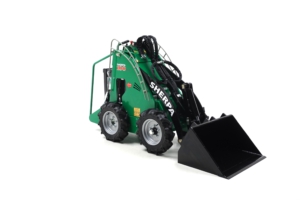
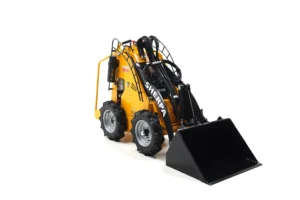
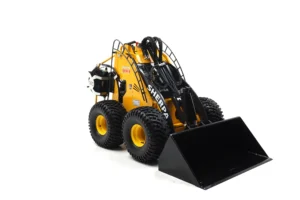
The Z40 is not the first SHERPA at AVO Stables. Years ago, Ad bought a used SHERPA 100. The machine was already well used at the time, but it went on to serve him reliably for many more years. “The old SHERPA never really let me down,” says Ad. “We had one or two flat tyres, and that was about it.”
Because the machine was only needed for a few hours each week, that old SHERPA suited the business perfectly for a long time. Until the engine eventually failed. A repair was possible, but would require a considerable investment. Ad contacted Daan at SHERPA, reviewed the options and costs, and decided it was time for a new machine. Choosing SHERPA again was no coincidence. The reliability of his old machine had already more than proven itself in practice. Ad also knew that SHERPA machines retain their value well.
Ad van Onzenoort, AVO Stables
Maneuvering in just nine square metres
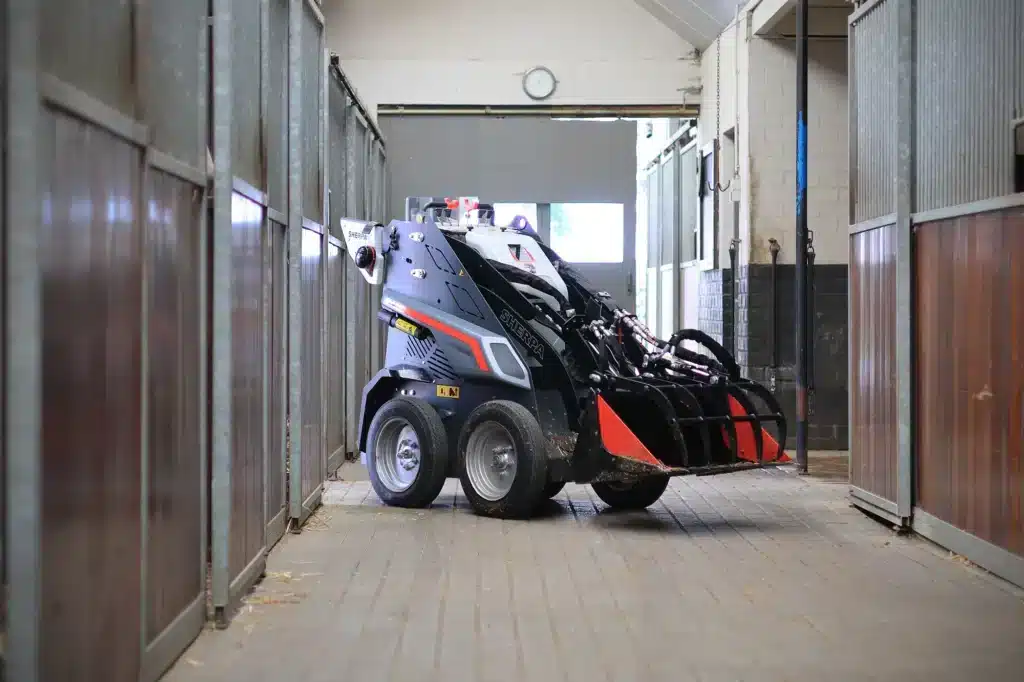
At a livery yard, the power of a machine is not the only thing that matters. Above all, it has to fit within the existing buildings. The horse stalls at AVO Stables measure three by three metres. The aisle is around 2.40 metres wide and the doors are 1.20 metres wide. So every centimetre counts. A larger machine may have plenty of power, but that is of little use to Ad if he cannot position it directly in front of a stall or manoeuvre inside. “I haven’t found another brand that can turn as tightly as this one,” says Ad. “A machine from another brand couldn’t make the turn inside a three-by-three-metre stall. With the SHERPA, it can.”
Thanks to its compact dimensions and articulated steering, Ad can drive the Z40 into the stall, turn around and remove the manure directly. In his situation, that is not just a nice extra, but a decisive feature.
From twelve man-hours to just two hours
The difference in labour is considerable. Previously, three people spent around four hours every Wednesday mucking out the stables and removing roughly 200 wheelbarrow loads of manure. That adds up to twelve man-hours.
Now, Ad does most of the work himself with the Z40. Only the last bits still need to be swept or shovelled towards the machine. “It used to take three of us an entire morning. Now we’re finished in two hours.”
That saves AVO Stables around ten man-hours every week. Ad is also far less dependent on staff availability, which is important in a sector where good people are difficult to find and retain. The biggest change, however, is the physical impact. Instead of lifting, pushing and emptying hundreds of full wheelbarrows, Ad simply operates the machine. The work is not only done faster, but is also considerably less physically demanding.
An attachment tailored to the stable
Ad uses a narrow 70-centimetre pelican bucket on his Z40. It fits through the doors more easily and gives him more room to manoeuvre inside the stalls. Because the doors are not positioned exactly in the centre of each stall and water pipes run along the walls, Ad has adjusted the teeth of the pelican bucket slightly inwards. This allows him to work more neatly in the corners and keep a safer distance from the pipes.
It is a small detail, but a good example of how users adapt their SHERPA and attachments to their daily work. No two stables, gardens or construction sites are the same. That is precisely why the added value often lies in the combination of a compact machine, the right attachment and a setup tailored to the job.
Performance and appearance
Of course, the new machine first and foremost had to perform well. But Ad also considered the design. There were cheaper alternatives, but he felt they looked much more ordinary. The Z40 stood out.
“I could have bought a cheaper machine, but I simply thought this one looked really good,” he says. “This is a modern machine. In five years’ time, it will still look modern.” When investing in a machine that needs to last for many years again, Ad believes appearance matters too. Performance ultimately made the difference, but the distinctive design certainly made the choice more appealing.
Getting more work done without overdoing it
At AVO Stables, the SHERPA Z40 is mainly used for one recurring task: mucking out the horse stalls. But with a weekly job like this, every task you can eliminate makes a difference.
Two hundred wheelbarrow loads and twelve man-hours have been reduced to just two hours of work. Three people have become one operator, with a little help for the final bits. Heavy physical labour has been replaced by precise manoeuvring. For Ad, the Z40 proves exactly what a miniloader is designed to do: not simply take over the work, but enable people to do the same job faster, more independently and, above all, with far less physical effort.
Curious which SHERPA is the best fit for your stable or workspace? Get in touch with us for personal advice or a demonstration.
Get in touch
Would you like more information or a demo to see for yourself what the SHERPA Z40 Miniloader can do for your business?










 +31 (0)412 - 613 344
 info@sherpaminiloaders.com